Comparison
Rail Island vs Cities: Skylines
Cities: Skylines is a city that happens to need transport. Rail Island is transport that happens to need a town. Both draw roads and rail freehand across a landscape, and after that they want completely different evenings from you.
Side by side
| Side by side | Rail Island | Cities: Skylines ↗ |
|---|---|---|
| What you can run | Trains, buses, trams, ships, aircraft and cable cars — nearly 350 vehicles, most of them railway and mostly Czech and European, each previewable in 3D before you buy into it. | Public transport of nearly every kind — buses, trams, metro, trains, monorail, ferries, cable cars, blimps and taxis, several of them through expansions — carrying citizens who genuinely need to get somewhere. |
| How you build | Free-angle. You click where the line should go, the game fits a real curve into the bend and shows you its radius, then grades the ground under it into cuttings and embankments. There is no square grid to fight. | Roads are drawn freehand with straight, curve and freeform tools, and the terrain can be sculpted; the zoning that fills in beside them snaps to a cell grid. |
| Towns and cities | Built, not simulated. Seed them with the island or drop a village, town or city with one click — street plan, plazas and all — then place the 137 buildings yourself where you want them. | The entire game. You zone, the buildings arrive on their own, and every citizen is simulated individually — the city grows or stalls on your services, traffic and budget. |
| Money and economy | None at all. No balance, no cargo payments, no loans, no bankruptcy. Nothing limits the railway you build except the island and your patience. | Yes. Taxes, a service budget, loans and milestones, and a city that goes bankrupt if you get it wrong. |
| Where it runs | In a browser, on desktop and on phones, with nothing to install and no console or store involved. Free, with an optional PLUS subscription at $3 a month. There is a Roblox edition too. | Paid. The 2015 original runs on Windows, macOS and Linux and on PlayStation, Xbox and Switch. Cities: Skylines II (2023) is Windows only — its console versions are indefinitely delayed, and development passed from Colossal Order to Iceflake Studios at the start of 2026. Neither has a browser version. |
Rail Island is not affiliated with any of the games on this page, and nothing here is written on their behalf. Everything said about them was checked against their own sites and store pages in September 2026; games change, so if something here has gone out of date, write to info@railisland.com and it will be corrected.
Who the game is really about
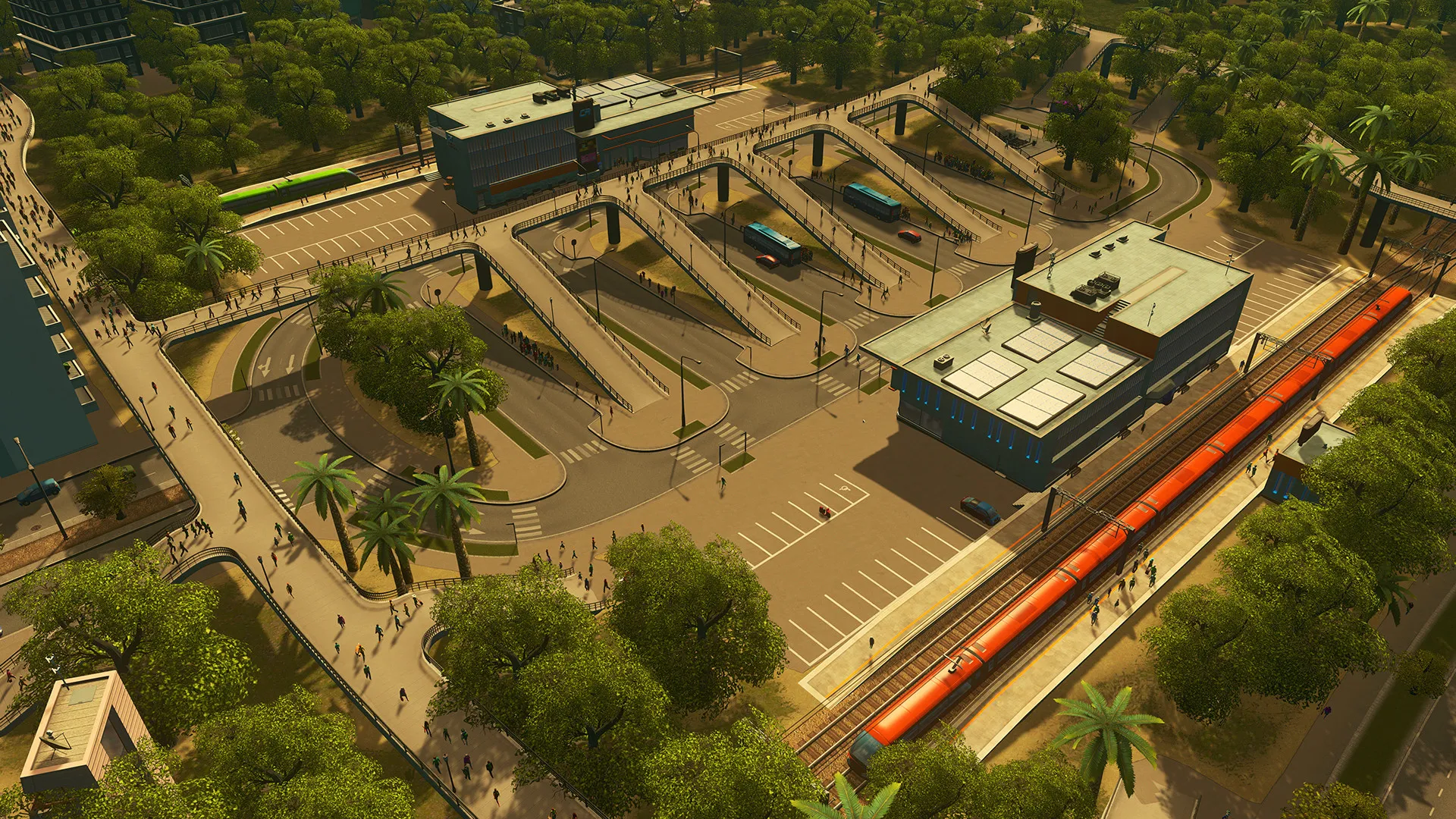
Cities: Skylines is a simulation of people. You zone land, the buildings arrive by themselves, and every citizen has a home, a job and a route between them. Transport exists because those citizens need it: a metro line is worth building when the traffic says so, and the game will tell you, at length, when you have got it wrong. It is one of the finest city builders ever made and the transport layer is a means to an end.
Rail Island simulates nobody. Towns do not fill themselves in and citizens do not commute — you place a village, town or city with the City tool, complete with its street plan and a church on the square, and then put 137 building models where you want them. The railway is not serving anyone. It is the thing you came to build, and the town is there to give it somewhere to go.
Drawing roads, drawing rail
Both games let you draw rather than stamp. Cities: Skylines has straight, curved and freeform road tools and full terrain sculpting, and the road network you draw is genuinely yours — but the zoning that fills in along it lies on a cell grid, which is what gives a Skylines city its characteristic blocks.
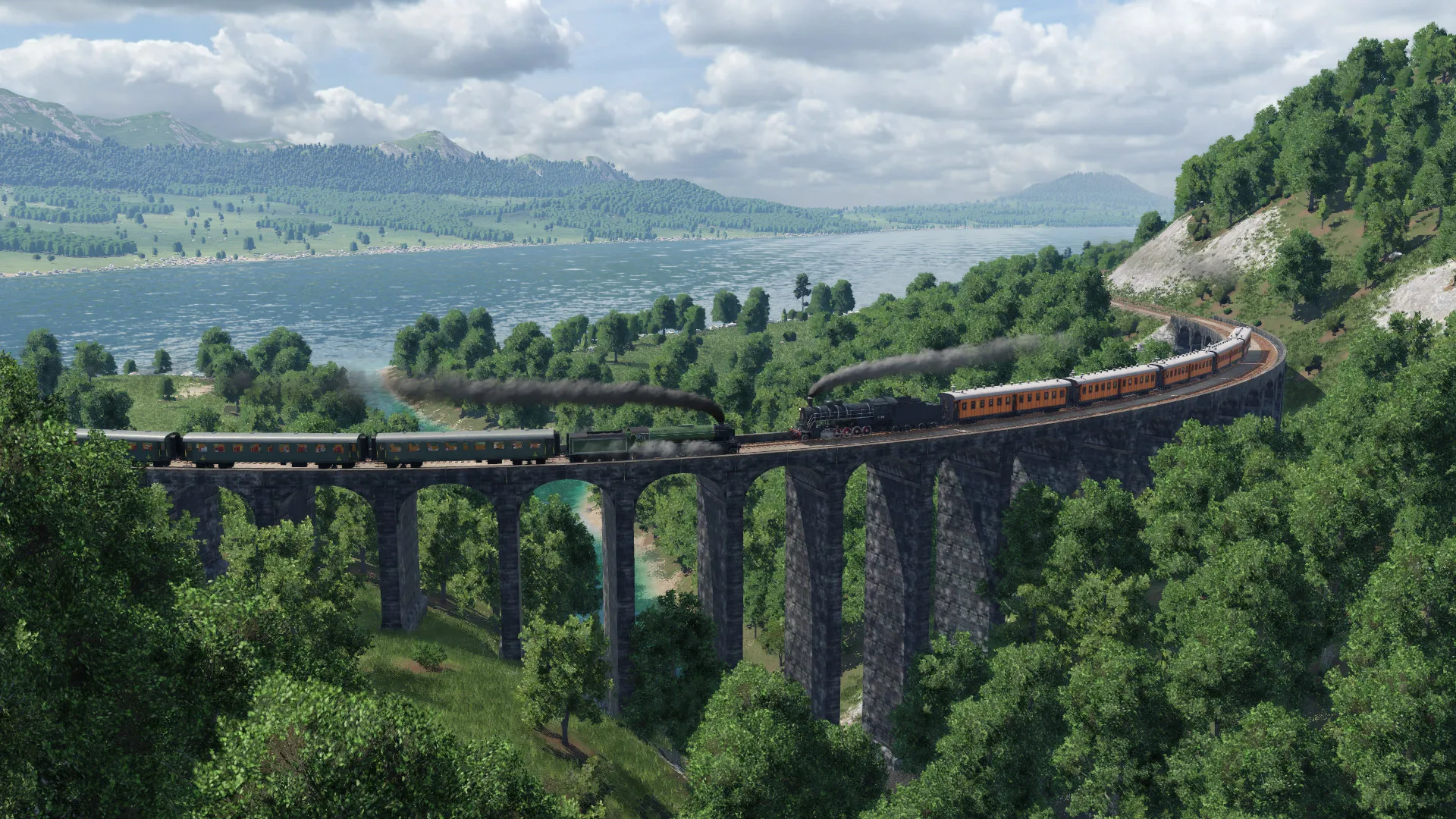
Rail Island has no zoning at all, and therefore no grid anywhere. Track is drawn point to point with a real arc fitted into each bend and its radius shown while you build, the ground grades itself into cuttings and embankments underneath, and roads are built by the same engine — including tram streets, and level crossings where a road meets the railway.
Traffic, and the absence of it
Traffic is why people love and curse Cities: Skylines. Every vehicle on the road is going somewhere specific, jams form for reasons you can trace, and rebuilding an interchange to fix one is a whole evening well spent. Rail Island models none of that. It has rail signals that keep several trains working one line, and level crossings where buses wait for a train, but nothing decides between your bus and their car, because there is no "them".
Money
Cities: Skylines gives you taxes, a service budget, loans and milestones, and a city can go broke. Rail Island prices nothing at all: no balance, no upkeep, nothing to unlock. Every build tool, including the whole Creator, is on the free plan from the first minute, and the optional PLUS subscription raises limits rather than unlocking any tool.
Where they run
The 2015 Cities: Skylines is the broadly available one: Windows, macOS and Linux, and versions for PlayStation, Xbox and Switch. Cities: Skylines II arrived in 2023 for Windows only, its PlayStation and Xbox versions are indefinitely delayed over performance, and development of the series moved from Colossal Order to Iceflake Studios at the start of 2026. Both are paid, both are heavy, and neither runs in a browser.
Rail Island runs in a browser tab on a desktop or a phone, free, with nothing to install and no store account. Add it to a home screen and it behaves like an app; sign in and your islands follow you between devices.
What Cities: Skylines does better
- Simulation. Thousands of individually simulated citizens, and a city that answers back — Rail Island has nothing remotely like it.
- Traffic. The best reason to build a transit line in any game, and the best feedback when it works.
- Scale and depth. Districts, policies, services, disasters, and a decade of expansions.
- Mods. One of the largest workshops in strategy gaming.
- It is the better game if you actually want to build a city, rather than a railway with a city attached.
So which one?
If the transit lines you love building in Skylines are the reason you play it, and the zoning and budgets are the tax you pay for them, Rail Island is that part on its own: track you draw by hand, terrain that moves for it, bridges and tunnels and a fleet to run — free, in a browser, with nobody complaining about the commute.
Questions people ask
- Is Rail Island a city builder like Cities: Skylines?
- No. Rail Island is a transport builder. Towns are placed by you — generated with the island or dropped by the City tool with their street plan — and nothing about them is simulated: no zoning, no citizens, no services and no growth. Cities: Skylines is a city simulation in which transport is one system among many.
- Does Rail Island simulate traffic like Cities: Skylines?
- No. There are rail signals that let several trains share a line and level crossings where buses wait for a train, but no congestion model and no citizens choosing between modes. Vehicles run the stop lists you give them.
- Is there a free browser game like Cities: Skylines?
- Rail Island is free and runs in a browser, but it builds transport rather than simulating a city — you shape the island, lay the track and place the towns yourself. If the city simulation is what you want, Cities: Skylines has no free browser equivalent.
- Does Cities: Skylines II run on Mac or console?
- Cities: Skylines II is Windows only; its PlayStation and Xbox versions have been indefinitely delayed and there is no macOS build. The 2015 original does run on Windows, macOS, Linux, PlayStation, Xbox and Switch.