Comparison
Rail Island vs NIMBY Rails
NIMBY Rails is for anyone who has looked at their own city and thought the metro should have gone the other way. It hands you the entire planet at centimetre resolution and lets you lay rail across it. Rail Island hands you an island nobody has ever been to, and no opinion about what you do with it.
Side by side
| Side by side | Rail Island | NIMBY Rails ↗ |
|---|---|---|
| What you can run | Trains, buses, trams, ships, aircraft and cable cars — nearly 350 vehicles, most of them railway and mostly Czech and European, each previewable in 3D before you buy into it. | Rail in every form — tram, metro, commuter, regional and high-speed — and nothing else. No road vehicles, no ships, no aircraft. |
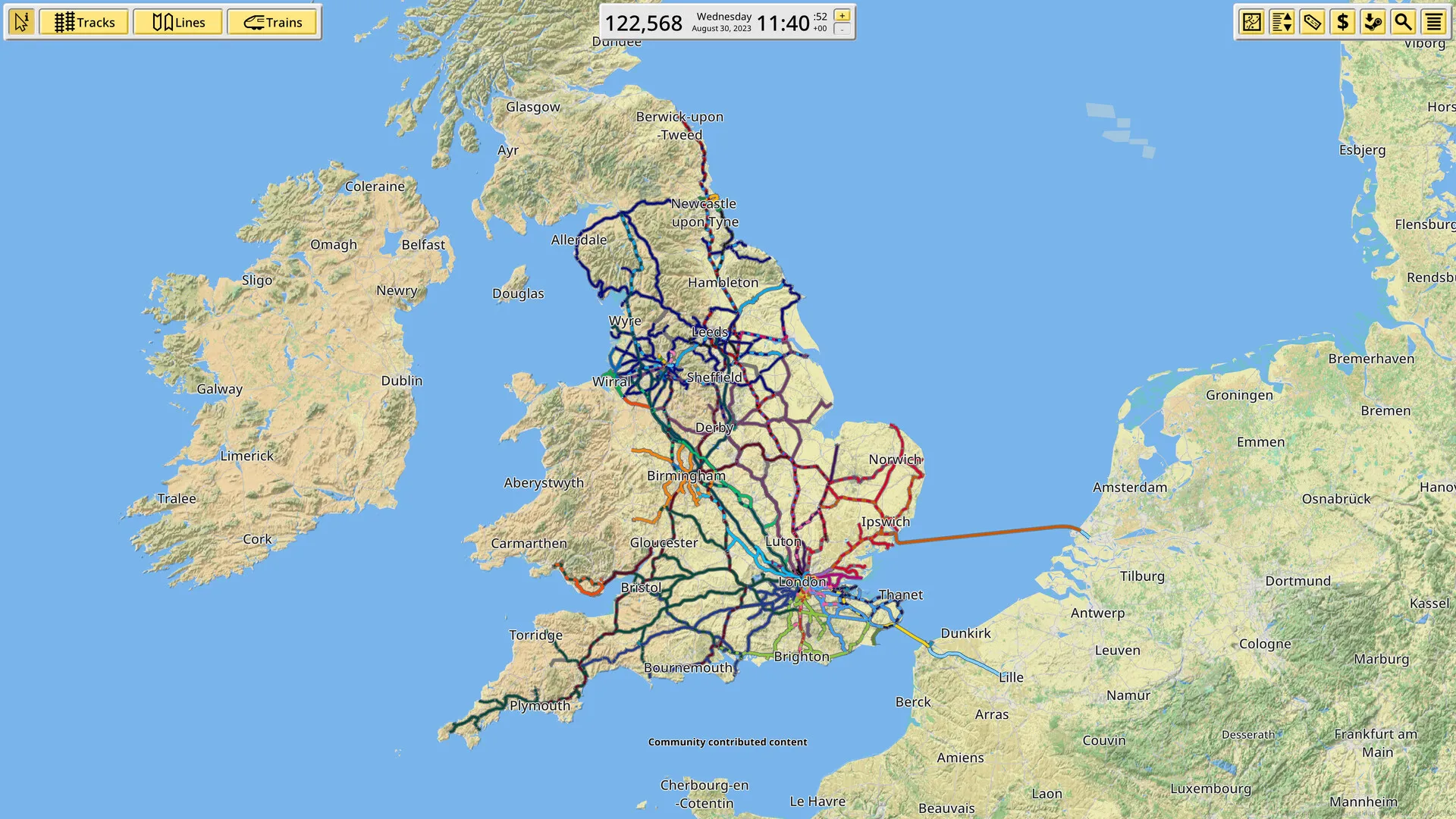
| How you build | Free-angle. You click where the line should go, the game fits a real curve into the bend and shows you its radius, then grades the ground under it into cuttings and embankments. There is no square grid to fight. | Free-form track drawn over the real world at 1cm resolution, threaded around the roads, streets and terrain OpenStreetMap already says are there. You shape the alignment; you do not shape the land. |
| Towns and cities | Built, not simulated. Seed them with the island or drop a village, town or city with one click — street plan, plazas and all — then place the 137 buildings yourself where you want them. | Real ones, every city on Earth, straight from map data. They do not grow and they do not react, because they are not simulated — they are the world as it is. |
| Money and economy | None at all. No balance, no cargo payments, no loans, no bankruptcy. Nothing limits the railway you build except the island and your patience. | Yes, and unusually detailed: individual simulated passengers, demand that changes by hour and weekday, fares, ratings and running costs. |
| Where it runs | In a browser, on desktop and on phones, with nothing to install and no console or store involved. Free, with an optional PLUS subscription at $3 a month. There is a Roblox edition too. | Paid ($19.99) on Steam for Windows and Linux, in Early Access since January 2021. The developer has said there will be no macOS port. No mobile or browser version. |
Rail Island is not affiliated with any of the games on this page, and nothing here is written on their behalf. Everything said about them was checked against their own sites and store pages in September 2026; games change, so if something here has gone out of date, write to info@railisland.com and it will be corrected.
The real world, or one you made
This is the whole difference and everything else follows from it. NIMBY Rails is played on the actual planet: every coastline, road and street comes from OpenStreetMap, so the challenge is the one a real railway engineer has — getting a viable alignment through a city that was built without asking you. Rail Island generates an island that has never existed, with the coastline, rivers, hills and towns you asked for on the create-island screen, and then lets you move all of it.
Two games that draw rather than snap
Of everything compared on this site, NIMBY Rails is the closest to Rail Island in the act of building. Neither has a tile grid. In both you set an alignment by hand, and the curve is a real curve rather than a staircase of diagonals. If free-angle track is what you are looking for, both of these have it and OpenTTD and Mashinky do not.
What Rail Island adds is the ground. Commit a chain of track and the game flattens a corridor to rail height and grades outward from it, turning a line across rolling country into a cutting and an embankment; you can raise, lower and repaint the terrain yourself with a brush before or after. NIMBY Rails deliberately will not do that — the world is not yours to edit, only to thread a line through, which is precisely the constraint that makes it interesting.
Passengers, and nobody at all
NIMBY Rails simulates people. Demand rises and falls through the day and the week, individual passengers decide whether your line is worth it, they rate the trip, and fares and running costs decide whether the line survives. A NIMBY Rails network is judged, constantly, by riders who do not care how elegant the junction is.
Rail Island has no passengers and no fares. A train is a consist and a list of stops; press Start and it assembles on a free platform at its home station and runs, because you want to watch it run. Semaphores cut a busy line into sectors so several trains can work it, and that is the whole of the operational model. Nothing is measuring you.
What runs on the network
NIMBY Rails is rail and only rail, which is a fair description of its ambition rather than a gap: trams, metro, commuter, regional and high-speed services, with a large workshop of real rolling stock behind it. Rail Island runs nearly 350 vehicles across six modes — trains, buses, trams, ships, aircraft and cable cars — on one fleet board, and the Creator takes your own .glb models beside them.
Where each one runs
NIMBY Rails is $19.99 on Steam, for Windows and Linux, and has been in Early Access since January 2021; the developer has said plainly that there will be no macOS port. Rail Island runs in a browser on any of those systems and on a phone as well, costs nothing to open, and saves to the cloud once you sign in.
What NIMBY Rails does better
- The real world. Building the line your own city should have had is something no invented island can offer.
- Passenger simulation down to the individual traveller, with demand that moves through the day.
- Scale. Planet-sized maps, and networks that can span countries.
- Timetabling and line planning with far more depth than Rail Island attempts.
- It has cooperative multiplayer; Rail Island is single-player, and islands are shared by publishing them.
So which one?
If the fun is the constraint — a real city, real distances, real riders — NIMBY Rails is doing something nothing else does. If the fun is the landscape, and you want to shape the valley as well as the line through it, and see it in three dimensions from a balloon moored over the rooftops, that is Rail Island, and it opens in a tab.
Questions people ask
- Is Rail Island like NIMBY Rails?
- They build alike — both draw free-angle track rather than snapping it to a grid — and differ in almost everything else. NIMBY Rails is played on the real world from OpenStreetMap data with simulated passengers and fares; Rail Island generates an island you can reshape, and has no passengers, fares or money at all.
- Can you edit the terrain in NIMBY Rails?
- No. The world comes from real map data and is not yours to reshape — the game is about threading an alignment through the geography that exists. Rail Island grades the ground under new track automatically and gives you terrain brushes on top of that.
- Does NIMBY Rails run on Mac or in a browser?
- NIMBY Rails is sold for Windows and Linux, and its developer has said there will be no macOS port; there is no browser or mobile version. Rail Island runs in any modern browser, which covers macOS, Windows, Linux, phones and tablets.
- Is there a free game like NIMBY Rails?
- Rail Island is free to play in a browser and builds track the same free-angle way, though on generated islands rather than the real world. OpenTTD is free and open-source too, but lays track on a tile grid.