Operations · 4 min read
Signals: running more than one train
One train needs no signals. Two trains on shared track need a rule about who goes first, and Rail Island has exactly one: a train may only pass a signal under a reservation for the stretch beyond it. Everything else follows from that.
Placing a signal
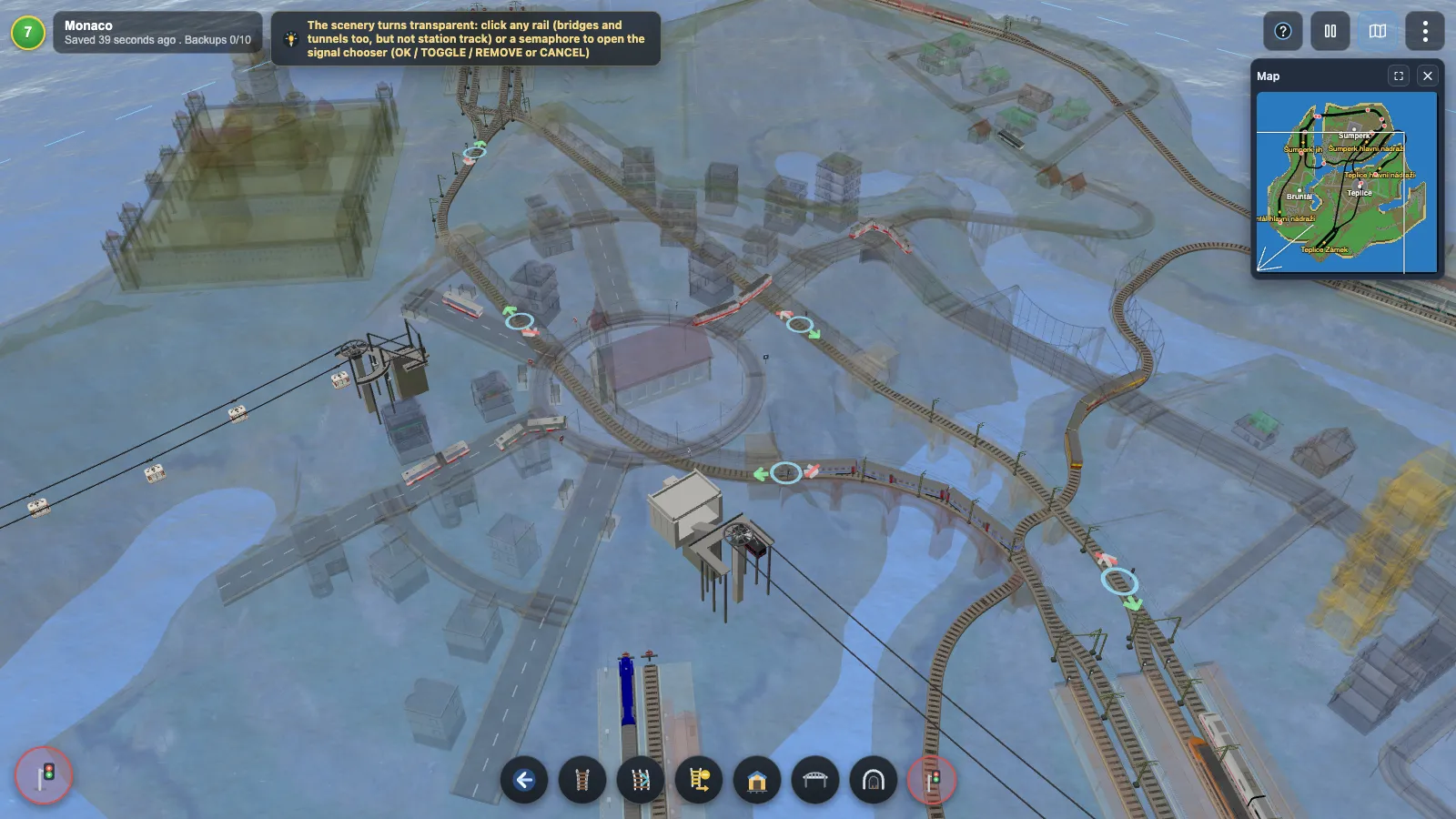
The Semaphore tool is the last item in the Railroad group, and selecting it changes how the island looks: terrain, buildings, stations, bridges, tunnels and roads all fade to transparent, and trees stop rendering altogether. Only rails and signals stay solid. That x-ray is not decoration — it is how you place a signal on track inside a tunnel or under a station roof, and how you see the shape of your whole network at once.
The signals you never place
Every station platform has an implicit signal at its end, derived from the station's own track layout rather than placed by you. They behave asymmetrically on purpose. Inbound they are ignored, so an arriving train pulls fully into the platform instead of stopping short of it. Outbound they are enforced, so a departing train holds at the platform end until it has a reservation for the road ahead. That single rule is what makes a multi-platform station work without you signalling its throat by hand.
How a train gets permission
Rail Island uses path reservations, and they are the only traffic control in the game. The sequence for one train is short:
- Near a signal, the train requests a corridor to the next signal or its target platform.
- The request is granted only if it conflicts with no occupied section or reserved junction.
- If refused, the train stops before the signal without holding a reservation.
- The corridor is released behind the train and cleared completely on arrival.
- Waiting trains retry in the order they asked as soon as track is released.
Where signals actually help
Because a reservation stretches from one signal to the next, signal spacing is the same as deciding how much track a train locks at a time. Too few signals and a train reserves half the island to leave a station. Too many on a single-track line does nothing at all — two trains still cannot share it.
- On double track, place signals at intervals in each direction; shorter blocks allow tighter headways.
- Place a signal on every approach before a junction.
- Signal both tracks at each end of a passing loop.
- Do not place signals inside stations; platforms already have them.
Where roads cross the rails
When a road and a railway cross, Rail Island builds a real level crossing: the two share a junction point, both lines are levelled flat through it, and the track is dressed rails-only across the road deck. A mast with two red lamps stands on each road approach, and while a train has the crossing claimed, they blink alternately.